Wireless connectivity
RF eliminates the need for physical wires between sites — which matters enormously where trenching fiber across lava rock, protected land, or open water is impractical or prohibitively expensive.
Radio frequency is the backbone of modern wireless communication — and the reason a business on a ridge in Kauai can have a circuit at all.
Radio Frequency (RF) technology refers to the use of electromagnetic waves to transmit data over distance. It is the crucial component in devices like mobile phones, Wi-Fi routers, radios, and satellite systems. RF operates within a range of frequencies — roughly 3 kHz to 300 GHz — allowing voice, data, and video to move without a physical connection between endpoints.
RF powers telecommunications, broadcasting, public safety radio, and even medical equipment. Its use in wireless networks enables everything from seamless internet access to real-time communication across long distances: cellular networks, radio and television broadcast, satellite links, and short-range applications like Bluetooth and NFC.
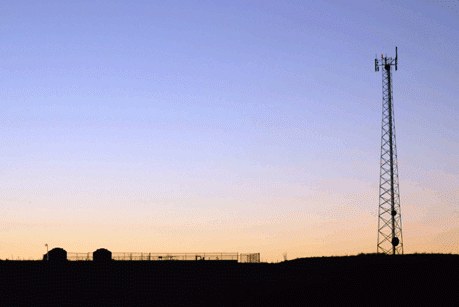
RF eliminates the need for physical wires between sites — which matters enormously where trenching fiber across lava rock, protected land, or open water is impractical or prohibitively expensive.
Properly engineered links cover substantial distances, which is what makes inter-island and ridge-to-valley connectivity possible without a physical plant in between.
The same underlying technology scales from a small personal device to a large industrial or carrier-class network — so a system can grow with the business instead of being replaced.
From enabling your smartphone on 4G or 5G to powering the Wi-Fi in your office, RF technology has transformed how we stay connected. As the technology evolves it continues to deliver faster speeds, better reliability, and greater spectral efficiency.
Designing an RF link well is mostly about the unglamorous parts: line of sight and Fresnel zone clearance, antenna gain and alignment, frequency and channel selection against the local noise floor, fade margin for weather, and mounting hardware that survives salt air and trade winds.
That is the work we do before quoting anything — a path study and, where warranted, an on-site survey. It is also why our links tend to stay up. A link that looks fine on paper and fails in a December squall was never actually designed; it was guessed at.
Curious whether your location can be served wirelessly? Give us the address and what you need it to carry. We will look at the path and tell you plainly whether it works, what it would take, and if the answer is no.
Tell us what's not working — slow connectivity, an aging phone system, a build-out on a new site. We'll tell you straight whether we're the right fit.